Candle Wick Size Chart: Sizing Guide for Containers
candlewaxcalculator.com/wick-size-chart
A container candle wick is sized from the inside diameter of the jar, adjusted for wax type, container shape and fragrance load. In soy wax at an 8% fragrance load, a 2 inch round jar takes a CD-10 to CD-12 cotton wick and a 3 inch jar takes a CD-18 to CD-20. Past 4 inches, use two or three wicks rather than one larger one.
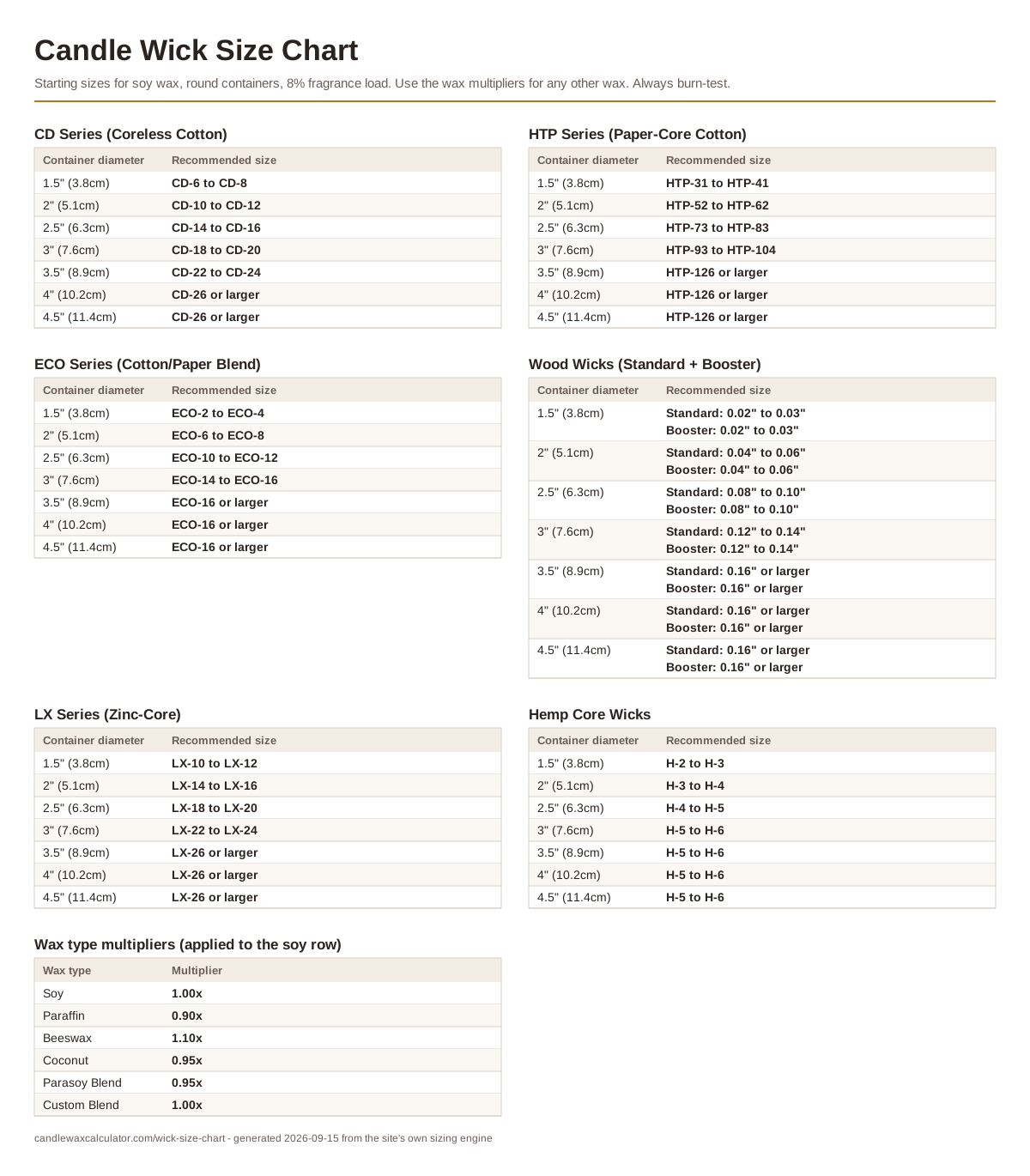
The six tables below cover CD, HTP and ECO cotton, wood, LX zinc-core and hemp wicks across seven container diameters. Every size is generated at build time by the same engine that powers the calculator, so the page, the print view and the PDF always agree.
What Wick Size Do I Need for My Container?
Start from the band your container falls into, then read the exact series size off the tables below. Each band links to the page that works that diameter through every wax type.
| Container Diameter | Wick Configuration | Full Melt Pool |
|---|---|---|
| 1 to 2 inches | One small wick | 1-2 hours to a full melt pool |
| 2 to 3 inches | One medium wick | 2-3 hours to a full melt pool |
| 3 to 4 inches | One large wick, or two small wicks | 3-4 hours to a full melt pool |
| 4 inches and wider | Two or three wicks, evenly spaced | 4 hours or more to a full melt pool |
How Wick Sizing Actually Works
Wick sizing is not a single lookup - it is a small calculation with four inputs: your container's diameter, your wax type, your container's shape, and your fragrance load. Our engine starts with the raw diameter in inches, then multiplies it by three factors before checking which size band it falls into.
The wax multiplier accounts for how hot and how densely each wax burns: soy and custom blends sit at a 1.0x baseline, paraffin burns hotter so it gets 0.9x (effectively sizing down), beeswax needs more heat to melt so it gets 1.1x (sizing up), and coconut or parasoy blends sit at 0.95x. The shape multiplier accounts for the extra wax volume in non-round containers: round stays at 1.0x, hexagon at 1.05x, square at 1.1x, and rectangle at 1.15x. The fragrance multiplier follows the formula 1 + (fragrance% - 6) x 0.02, so every point of fragrance load above 6% nudges the effective diameter up by 2%.
Multiply your diameter by all three factors and you get an "adjusted diameter," which the engine checks against fixed size bands (up to 2", up to 2.5", up to 3", and so on) for whichever wick family you picked. The tables below run that exact calculation for every diameter, wax type, and wick family combination so you do not have to do the math by hand - though for your specific container, the calculator on our homepage will still give the most precise single answer.
The Master Chart (Soy Wax, Round Containers)
Starting sizes at an 8% fragrance load, the calculator's own default. Use the wax adjustment table further down if you are not using soy.
CD Series (Coreless Cotton)
| Container Diameter | Recommended Size |
|---|---|
| 1.5" (3.8cm) | CD-6 to CD-8 |
| 2" (5.1cm) | CD-10 to CD-12 |
| 2.5" (6.3cm) | CD-14 to CD-16 |
| 3" (7.6cm) | CD-18 to CD-20 |
| 3.5" (8.9cm) | CD-22 to CD-24 |
| 4" (10.2cm) | CD-26 or larger |
| 4.5" (11.4cm) | CD-26 or larger |
HTP Series (Paper-Core Cotton)
| Container Diameter | Recommended Size |
|---|---|
| 1.5" (3.8cm) | HTP-31 to HTP-41 |
| 2" (5.1cm) | HTP-52 to HTP-62 |
| 2.5" (6.3cm) | HTP-73 to HTP-83 |
| 3" (7.6cm) | HTP-93 to HTP-104 |
| 3.5" (8.9cm) | HTP-126 or larger |
| 4" (10.2cm) | HTP-126 or larger |
| 4.5" (11.4cm) | HTP-126 or larger |
ECO Series (Cotton/Paper Blend)
| Container Diameter | Recommended Size |
|---|---|
| 1.5" (3.8cm) | ECO-2 to ECO-4 |
| 2" (5.1cm) | ECO-6 to ECO-8 |
| 2.5" (6.3cm) | ECO-10 to ECO-12 |
| 3" (7.6cm) | ECO-14 to ECO-16 |
| 3.5" (8.9cm) | ECO-16 or larger |
| 4" (10.2cm) | ECO-16 or larger |
| 4.5" (11.4cm) | ECO-16 or larger |
Wood Wicks (Standard + Booster)
| Container Diameter | Recommended Size |
|---|---|
| 1.5" (3.8cm) | Standard: 0.02" to 0.03" / Booster: 0.02" to 0.03" |
| 2" (5.1cm) | Standard: 0.04" to 0.06" / Booster: 0.04" to 0.06" |
| 2.5" (6.3cm) | Standard: 0.08" to 0.10" / Booster: 0.08" to 0.10" |
| 3" (7.6cm) | Standard: 0.12" to 0.14" / Booster: 0.12" to 0.14" |
| 3.5" (8.9cm) | Standard: 0.16" or larger / Booster: 0.16" or larger |
| 4" (10.2cm) | Standard: 0.16" or larger / Booster: 0.16" or larger |
| 4.5" (11.4cm) | Standard: 0.16" or larger / Booster: 0.16" or larger |
LX Series (Zinc-Core)
| Container Diameter | Recommended Size |
|---|---|
| 1.5" (3.8cm) | LX-10 to LX-12 |
| 2" (5.1cm) | LX-14 to LX-16 |
| 2.5" (6.3cm) | LX-18 to LX-20 |
| 3" (7.6cm) | LX-22 to LX-24 |
| 3.5" (8.9cm) | LX-26 or larger |
| 4" (10.2cm) | LX-26 or larger |
| 4.5" (11.4cm) | LX-26 or larger |
Hemp Core Wicks
| Container Diameter | Recommended Size |
|---|---|
| 1.5" (3.8cm) | H-2 to H-3 |
| 2" (5.1cm) | H-3 to H-4 |
| 2.5" (6.3cm) | H-4 to H-5 |
| 3" (7.6cm) | H-5 to H-6 |
| 3.5" (8.9cm) | H-5 to H-6 |
| 4" (10.2cm) | H-5 to H-6 |
| 4.5" (11.4cm) | H-5 to H-6 |
Adjusting for Wax Type
The master chart above uses soy as the reference wax. If you pour a different wax, apply its multiplier to shift up or down from the soy row.
| Wax Type | Multiplier | What It Means |
|---|---|---|
| Soy | 1.00x | Baseline. Every other wax multiplier below is relative to this row. |
| Paraffin | 0.90x | Burns hotter and pools faster than soy - size down from the soy row. |
| Beeswax | 1.10x | High melting point needs more heat to form a full melt pool - size up from the soy row. |
| Coconut | 0.95x | Slightly softer than soy with strong container adhesion - size down a fraction from the soy row. |
| Parasoy Blend | 0.95x | Sits between soy and paraffin in melt behavior - size down a fraction from the soy row. |
| Custom Blend | 1.00x | Custom blends vary by recipe - treat as soy baseline until you run a burn test on your specific mix. |
What Goes Wrong When the Wick Size Is Off
A wick is the right size when the melt pool reaches the container wall within two to four hours and the flame stays under three quarters of an inch. Miss in either direction and the candle tells you which way you missed.
Underwicked (too small)
- Tunnels down the center
- Weak, struggling flame
- Wax left clinging to the walls
- Poor scent throw
Correctly wicked
- Edge-to-edge melt pool in 2-4 hours
- Stable, controlled flame
- Even wax consumption to the base
- Scent carries without smoking
Overwicked (too large)
- Flame taller than 1 inch
- Smoking and soot on the glass
- Container running hot to the touch
- Wax burning off far too fast
Additives and Dyes the Chart Cannot See
The tables above size for wax type, container shape and fragrance load. They do not know what else went into your melt, and three additives shift the answer often enough to be worth checking before you order wicks in quantity.
- Vybar and similar hardeners. They stiffen the wax, so the melt pool spreads more slowly and the wick usually needs to come up a size.
- Stearic acid. It raises the melting point, which is the same problem beeswax has - expect to size up, in the same direction the beeswax multiplier points.
- Heavy dye loads. Pigment can clog the braid and choke the flame. Dye blocks and heavily coloured candles often need a size up, or a switch to a cored series that keeps the wick upright.
None of these is a reason to skip the burn test. They are a reason to test a size above your chart reading as well as the chart reading itself.
Wick Constructions and Why the Series Behave Differently
Each series in the chart is a construction as much as a size scale, which is why a CD number and an LX number are not interchangeable even when the digits match.
Flat braided cotton
The classic container wick. It curls slightly as it burns, which self-trims the carbon cap and keeps the flame steady through a long burn.
Square braided cotton
A tighter braid with a stronger curl. Built for pillars and votives, where the wick is exposed rather than sitting in a jar.
Cored cotton (paper or zinc)
A rigid core holds the wick upright while the wax is still liquid, which is what makes it the safe pick for deep containers. The LX zinc-core series in the chart above is this construction.
Wood
A flat or booster-backed wood strip. It burns lower and wider than cotton, crackles, and is sized in fractions of an inch rather than on a series number, so it needs its own column in the chart.
When One Wick Isn't Enough
Every table above assumes a single, centered wick. That stops being the right model once a container gets wide enough that one flame cannot melt the whole surface before the outer wax starts to reharden. As a general rule of thumb from the craft (not a specific engine output, since multi-wick spacing is a placement problem rather than a size lookup): containers in the 3 to 4 inch range often perform better with a single larger wick or two smaller wicks spaced roughly 1.5 inches apart, 4 to 5 inch containers usually want three wicks in a triangular layout, and anything past 5 inches typically needs three or four wicks spaced evenly across the surface.
Multiple wicks put more heat into the container at once, so before you multi-wick a candle, confirm the container is rated for the higher sustained temperature - see our container selection guide for heat-rating guidance.
Burn-Test Protocol
Every chart on this page is a starting point, not a guarantee. Professional candle makers test every new wax, fragrance, and container combination before selling it.
Burn Test Setup
- Test at least 3 different wick sizes (one smaller, recommended, one larger)
- Use identical wax, fragrance load, and container for each test
- Burn for 2-4 hour intervals, documenting melt pool progress
- Measure melt pool diameter at each hour mark
- Note any mushrooming, smoking, or flickering issues
Optimal Performance Signs
- Melt pool reaches container edge in 2-3 hours
- Flame height: 1/2" to 3/4"
- Minimal to no mushrooming
- Even, complete wax consumption
- Strong scent throw without smoking
Warning Signs
- Melt pool never reaches edges (wick too small)
- Flame over 1" tall (wick too large)
- Excessive mushrooming or carbon buildup
- Smoking or sooting
- Tunneling or uneven burning
Frequently Asked Questions
What wick size do I need for a 3 inch container?
For a 3 inch diameter container in soy wax with a round shape and an 8% fragrance load, our sizing engine recommends a CD-18 to CD-20 cotton wick (CD series) as a starting point. See the full breakdown across all wick families and wax types on our dedicated 3 inch container page, then confirm with a burn test.
Does fragrance load change my wick size?
Yes. Our engine applies a fragrance multiplier of 1 + (fragrance% - 6) x 0.02, so a 6% fragrance load multiplies the effective diameter by 1.00 while a 10% load multiplies it by 1.08. Heavier fragrance loads push more oil into the melt pool, which burns hotter - so higher fragrance percentages nudge you toward a slightly larger wick. Check your wax type's safe fragrance range on the fragrance load calculator before you pick a percentage to size from.
Are wood wicks and cotton wicks sized the same way?
No. Wood wicks use their own thickness scale (measured in fractions of an inch, e.g. 0.08" to 0.10") rather than the CD/HTP/ECO numbering cotton wicks use, and they burn differently - lower and wider with a distinctive crackle. Never substitute a cotton wick size directly onto a wood-wick chart or vice versa; use the wood-wick column for wood wicks.
Does container shape change the recommended wick size?
Yes. Square, rectangular, and hexagonal containers hold more wax per inch of diameter than a round container of the same width, so our engine applies a shape multiplier: round is the baseline (1.00x) while square containers get a 1.10x multiplier, meaning you typically need to size up slightly for non-round shapes.
What do the CD, HTP, and ECO numbers actually mean?
They are manufacturer size codes, not measurements you can convert between brands. Within a single series the number is a relative scale - a CD-16 is thicker and burns hotter than a CD-10 - but a CD-16 is not directly equivalent to an ECO-16 or an HTP-16. Always shop within one series and use its own chart.
My container is over 4 inches wide - do I need multiple wicks?
Usually yes. Past roughly 4 inches of diameter, a single wick struggles to pull enough wax into the melt pool without overheating the center, so most chandlers switch to two or three wicks spaced evenly across the surface rather than one oversized wick. See the multi-wick section below for spacing guidance.
How do I convert a wick size between brands?
You test it rather than convert it. Most suppliers publish a conversion chart, but two wicks labelled as equivalents can still pull different amounts of wax because the braid, the core and the treatment differ between manufacturers. Treat any conversion chart as the starting size for a fresh burn test, not as a finished answer.
Why does a correctly sized wick still tunnel?
Almost always because of the first burn. A candle keeps the melt pool diameter it reached the first time it was lit, so if that first burn stopped short of the container edge, every burn after it tunnels down the same channel. Allow roughly one hour of burn time per inch of container diameter on the first light, and the wick size stops being the suspect.
Do altitude, humidity and drafts change the wick size?
Yes, enough to matter. Thinner air at altitude gives the flame less oxygen and often calls for a slightly smaller wick than the chart says, while a draft pulls the flame sideways and burns one wall of the candle faster than the other. Run your burn tests in the room you actually pour and store in, not in a different building.
Can I use the same wick size for every wax?
No. Wax type is one of the four inputs the sizing engine uses, and the multipliers below range from 0.90x for paraffin to 1.10x for beeswax - a spread wide enough to move you a full size or two in the same container. Size from the wax you are actually pouring, and retest whenever you change supplier or blend.
Want an Exact Recommendation?
These charts use round-number defaults. Get a recommendation for your exact container diameter, wax type, and fragrance load with our free wick calculator.
Once you know your size, these suppliers stock cotton, wood, zinc-core, and hemp wicks: