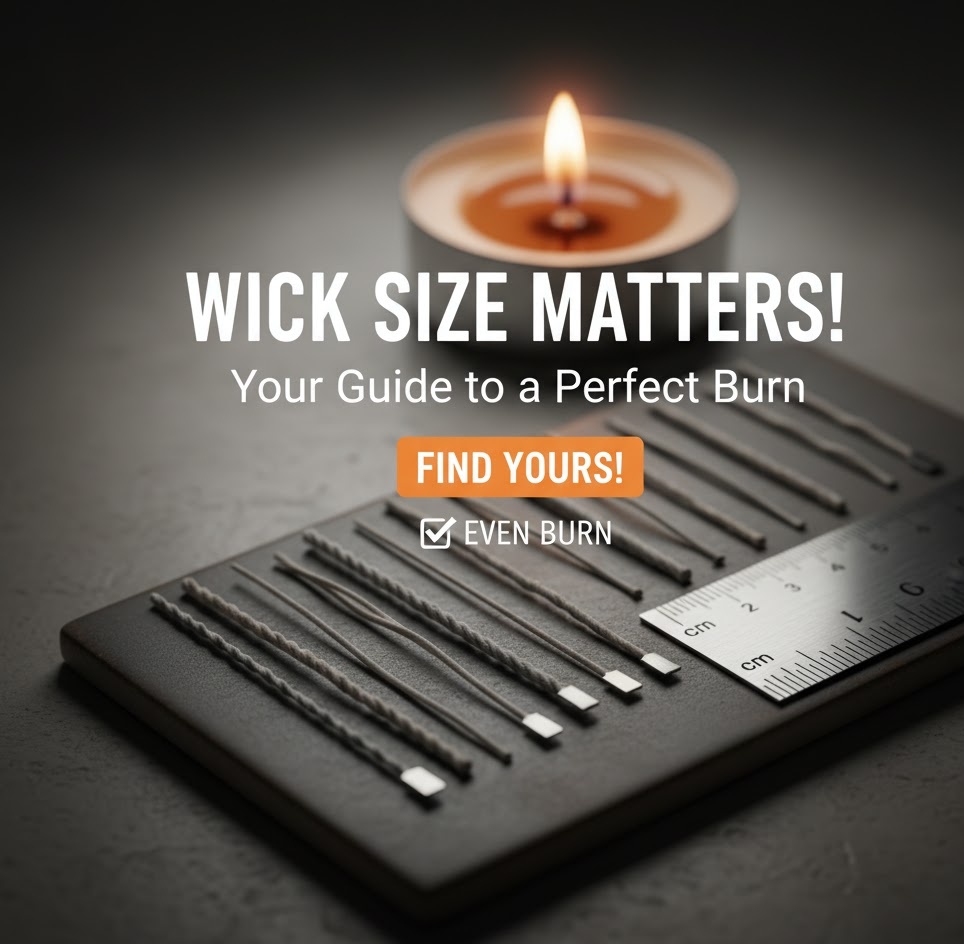

Selecting the right wick is the most critical decision in candle making, directly impacting burn quality, scent throw, and safety. Master the science of wick selection with this comprehensive, tested methodology.
Quick Reference: Wick Size by Container Diameter
1-2"
Single small
2-3"
Single medium
3-4"
Single large or 2 small
4+"
Multiple wicks
These are starting points -always test for your specific wax and fragrance combination.
1 Why Wick Size Matters
The perfect wick creates an optimal melt pool that extends to the container edges without overheating. Getting it right is essential for candle performance:
Too Small (Underwicked)
- ✗Tunneling down the center
- ✗Poor scent throw
- ✗Wax wasted on the sides
- ✗Weak, struggling flame
Just Right (Optimal)
- ✓Edge-to-edge melt pool in 2-4 hours
- ✓Excellent scent diffusion
- ✓Stable, controlled flame
- ✓Maximum candle life
Too Large (Overwicked)
- ✗Excessive smoking and soot
- ✗Flame taller than 1 inch
- ✗Overheated container
- ✗Rapid wax consumption
2 Key Factors Affecting Wick Selection
Multiple variables work together to determine the optimal wick for your candle:
Container Diameter (Primary Factor)
The wider your container, the larger or more numerous your wicks must be to achieve a complete melt pool:
| Diameter | Wick Configuration | Full Melt Pool Time |
|---|---|---|
| 1-2 inches | Single small wick | 1-2 hours |
| 2-3 inches | Single medium wick | 2-3 hours |
| 3-4 inches | Single large or two small wicks | 3-4 hours |
| 4+ inches | Two to three wicks evenly spaced | 4+ hours |
For precise calculations based on your exact dimensions, use our Candle Wax Calculator.
Wax Type Considerations
Different waxes have varying densities and melting points:
- Soy wax: Often requires slightly larger wick
- Paraffin: Burns hotter, may need smaller wick
- Beeswax: Higher melting point, needs larger or specialized wicks
- Coconut: Similar to soy, excellent scent throw
See our Temperature Control Guide for wax-specific temperature advice.
Fragrance Load Impact
Higher fragrance loads require larger wicks:
- Low (1-5%): Standard wick size
- Medium (6-8%): Increase wick one size
- High (9-12%): Increase wick two sizes
Learn more in our Fragrance Load Science guide.
⚠️ Additives & Dyes
Various additives affect burning and may require wick adjustment:
- !Vybar: Hardens wax, may need larger wick
- !Stearic acid: Raises melting point, often needs larger wick
- !Heavy dyes: Can clog wicks, may require larger sizes
3 Types of Wicks
Understanding different wick constructions helps optimize performance:
Cotton Wicks
Flat Braided
Classic design, excellent for container candles and consistent burns.
Square Braided
Self-trimming curl, ideal for pillars and votives.
Cored (Paper/Zinc)
Rigid core maintains position, perfect for deep containers.
Wooden Wicks
- ♪Creates distinctive crackling ambience
- ♪Provides wider, shallower melt pool
- ♪Requires dedicated sizing charts
- ♪Premium sensory experience
4 Professional Testing Protocol
Never skip testing. Follow this scientific approach for consistent results:
Burn Test Methodology
- 1
Prepare Test Candles
Create identical containers with the same wax, fragrance, and dye. Only vary wick size/type. Label clearly.
- 2
Conduct Initial Burn
Burn for 3-4 hours. Measure melt pool diameter at one-hour intervals.
- 3
Document Observations
Record flame height, smoking, soot, container temperature, and time to full melt pool.
- 4
Cool & Repeat
Allow complete cooling between tests. Burn at least three times to confirm consistency.
- 5
Evaluate Performance
Select the wick that achieves a full melt pool within 2-4 hours with a stable flame and minimal soot.
What to Look For
✓ Perfect Wick Indicators
- • Full melt pool reached by third burn
- • Flame height between 1/2" and 1"
- • Minimal to no smoking or soot
- • Container warm but safe to touch
- • No mushrooming or carbon build-up
✗ Problem Indicators
- • Tunneling or incomplete melt pool
- • Flame taller than 1" or constant flickering
- • Excessive smoking, soot, or carbon buildup
- • Container dangerously hot
- • Mushrooms every burn
5 Multiple Wick Configuration
For wider containers (3+ inches), multiple wicks often perform better than a single large wick:
Multiple Wick Guidelines
- 2
3-4 inch containers
Use two wicks spaced 1.5" apart.
- 3
4-5 inch containers
Use three wicks in triangular formation.
- 4
5+ inch containers
Use three or four wicks evenly spaced.
Important: Multiple wicks generate more heat. Ensure your container is heat-rated to 200°F+ to prevent cracking or shattering.
Frequently Asked Questions
How do I convert between different wick brands?
Most suppliers provide conversion charts. However, wicks from different manufacturers can perform differently even at "equivalent" sizes. Always conduct burn tests when switching brands.
Why does my correctly sized wick still tunnel?
The first burn is critical. If the initial burn doesn’t create a full melt pool reaching the container edges, the candle will “remember” that pattern and continue tunneling. Always burn new candles long enough on the first use to achieve a complete melt pool (about 1 hour per inch of diameter).
How do environmental factors affect wicking?
Altitude, humidity, and airflow all impact burn performance. High altitude reduces oxygen, sometimes requiring smaller wicks. Drafts cause uneven burning. Test candles in your production environment and provide customer guidance.
Can I use the same wick for all wax types?
No. Different waxes have varying densities and melting points that affect burn characteristics. A wick perfect for soy wax may be too small or too large for paraffin or beeswax. Always test wicks with the specific wax you plan to use.
Quick-Reference Chart (Soy Wax, CD Series)
Generated from the same sizing engine that powers our calculator, so these numbers stay in sync with the tool itself.
| Container Diameter | CD Wick Size (Soy, Round, 8% Fragrance) |
|---|---|
| 1.5" (3.8cm) | CD-6 to CD-8 |
| 2" (5.1cm) | CD-10 to CD-12 |
| 2.5" (6.3cm) | CD-14 to CD-16 |
| 3" (7.6cm) | CD-18 to CD-20 |
| 3.5" (8.9cm) | CD-22 to CD-24 |
| 4" (10.2cm) | CD-26 or larger |
| 4.5" (11.4cm) | CD-26 or larger |
Want the full picture?
See the complete printable wick size chart covering cotton, wood, zinc-core, and hemp wicks across every wax type, or jump straight to your container size: 2", 2.5", 3", 3.5", and 4" containers.
Or get a recommendation for your exact container: try our candle calculators →
Calculate Your Perfect Wick Size Now
Take the guesswork out of wick selection. Our professional calculator provides scientifically accurate recommendations based on your container size, wax type, and fragrance load.
Try Our Wax Calculator →